

The fastest way to memorise a speech is not to memorise a script at all. Memorise your main ideas and the order they come in, then practise saying them out loud. You will remember it faster, and you will sound natural instead of recited.
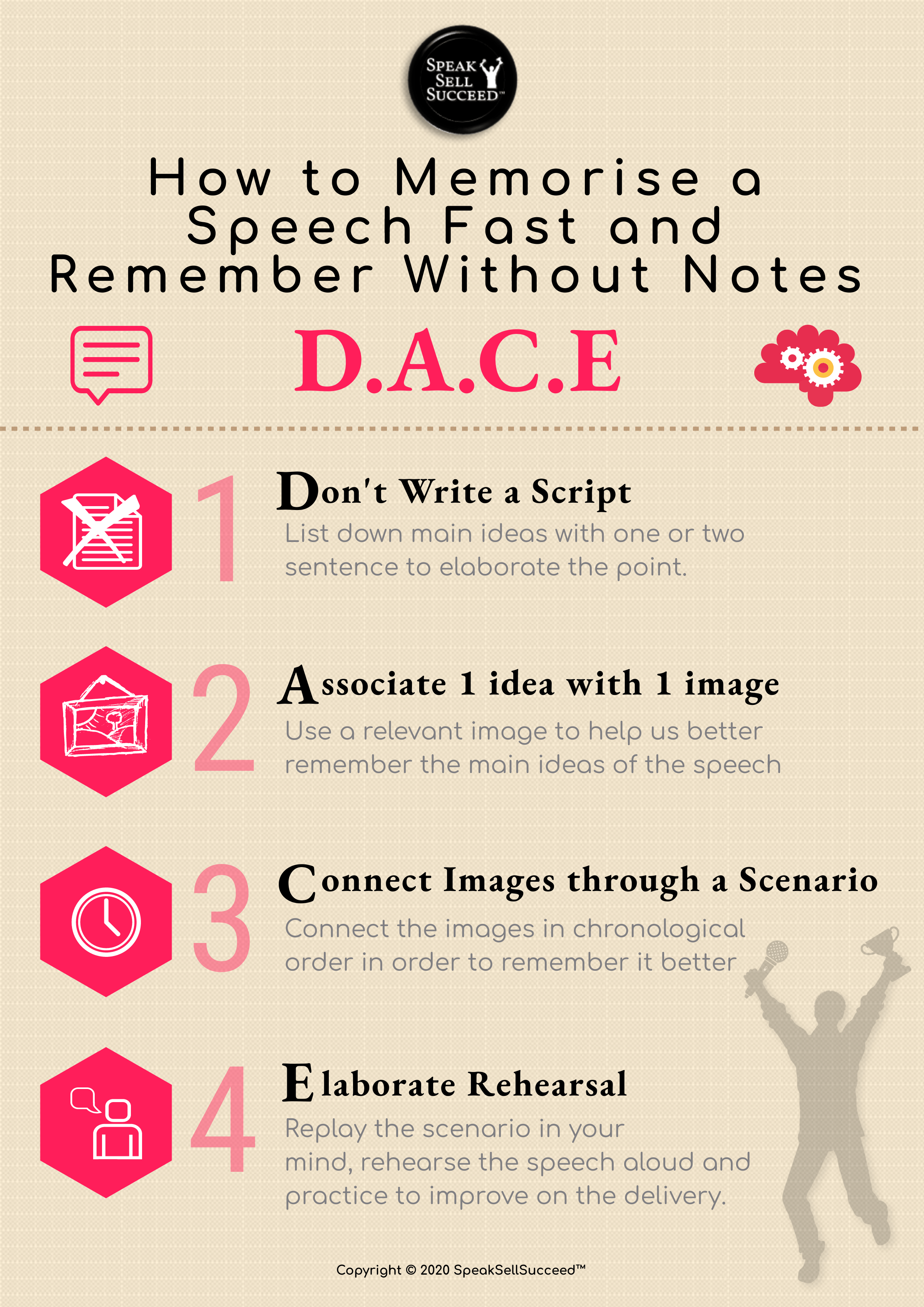
Here is a four-step method we call DACE: Don't write a script, Associate each idea with an image, Connect the images in a story, and Elaborate through rehearsal.
Why speak without notes?
Speakers who talk without notes tend to come across as authentic, confident and enthusiastic.
- Authentic. When you are not reading, the audience feels you know and believe what you are saying.
- Confident. It shows you have prepared, which makes your message more convincing.
- Enthusiastic. It shows you cared enough about the topic to put in the work.
Speakers like Gary Vaynerchuk and Scott Harrison of charity: water have given 45-minute and hour-long talks at large conferences without reading from notes. You don't need to be famous to do the same. You need a method.
How to memorise a speech fast: the DACE method
1. Don't write a script
Writing a full script and polishing it takes hours. Learning it word for word takes even longer, and it makes you sound stiff, because you are trying to recall sentences instead of speaking. If you forget one word, you can lose the whole thread.
Instead, list your main ideas, with one or two sentences under each. That is all you need to remember.
2. Associate one idea with one image
Give each main idea a simple picture. Research shows that we remember pictures better than words, so the image becomes a hook for the idea.
3. Connect the images in a story
Link your images into a short scene that runs in order, like a day in your life. The story holds the order of your speech for you.
Say your speech is about what matters to young professionals: eating well, music and travel. Your scene might be:
- Eating a salad for breakfast
- Listening to music on the way to work
- Reading a travel book before bed
Run through the scene and each image brings back its point.
4. Elaborate through rehearsal
Play the scene in your mind until you can run through it without effort. Then rehearse the speech out loud, ideally in front of people you trust, and ask for feedback. Each run will sound a little different, and that is fine. You are remembering ideas, not words.
Tips for the day
- Learn your opening and closing lines word for word. They are the two moments that matter most, and knowing them cold settles your nerves.
- Keep a backup. Write your images or keywords on a small card. You may never look at it, but knowing it is there helps.
- If you lose your place, pause. Think of the next image in your story. A short pause looks thoughtful to the audience.
Related guides
- Overcome stage fright and presentation anxiety
- How to use the right tone of voice
- How to improve your speaking voice
About Speak Sell Succeed
Speak Sell Succeed teaches public speaking, presentation and communication skills to working adults in Singapore. Every course is taught in person by our founder, Iwan Yang, at our centre in Tanjong Pagar. Iwan has more than ten years of speaking and training experience and has personally trained more than 3,000 people.
Structure is what makes a speech easy to remember. In our Presentation Skills & Public Speaking course, you learn to structure your thoughts and practise speaking without a script, with feedback from Iwan.
Eligible Singapore Citizens can use SkillsFuture Credit for our courses, and NTUC members can claim UTAP. See upcoming course dates or message us on WhatsApp if you would like help choosing.
Frequently asked questions
How long does it take to memorise a speech?
It depends on the length of the speech and how often you rehearse. Remembering a handful of ideas in order is much faster than learning a full script word for word.
Should I memorise my speech word for word?
Usually not. Learn your opening and closing lines word for word and remember the rest as ideas in order. You will sound more natural and recover more easily if you lose your place.
Is it okay to use notes when giving a speech?
Yes. A small card with keywords is a sensible backup. Avoid reading from it so you can keep eye contact with the audience.
What if I forget part of my speech?
Pause, breathe and think of the next image in your story, or glance at your keywords. The audience doesn't know your script, so a short pause rarely shows.